Part of the Story

Heritage Frederick is very excited to be able to announce the arrival of a new portrait to the collection painted by an old friend. This unidentified man was painted by John Johnston Markell, one of Frederick’s earliest artists of note. 
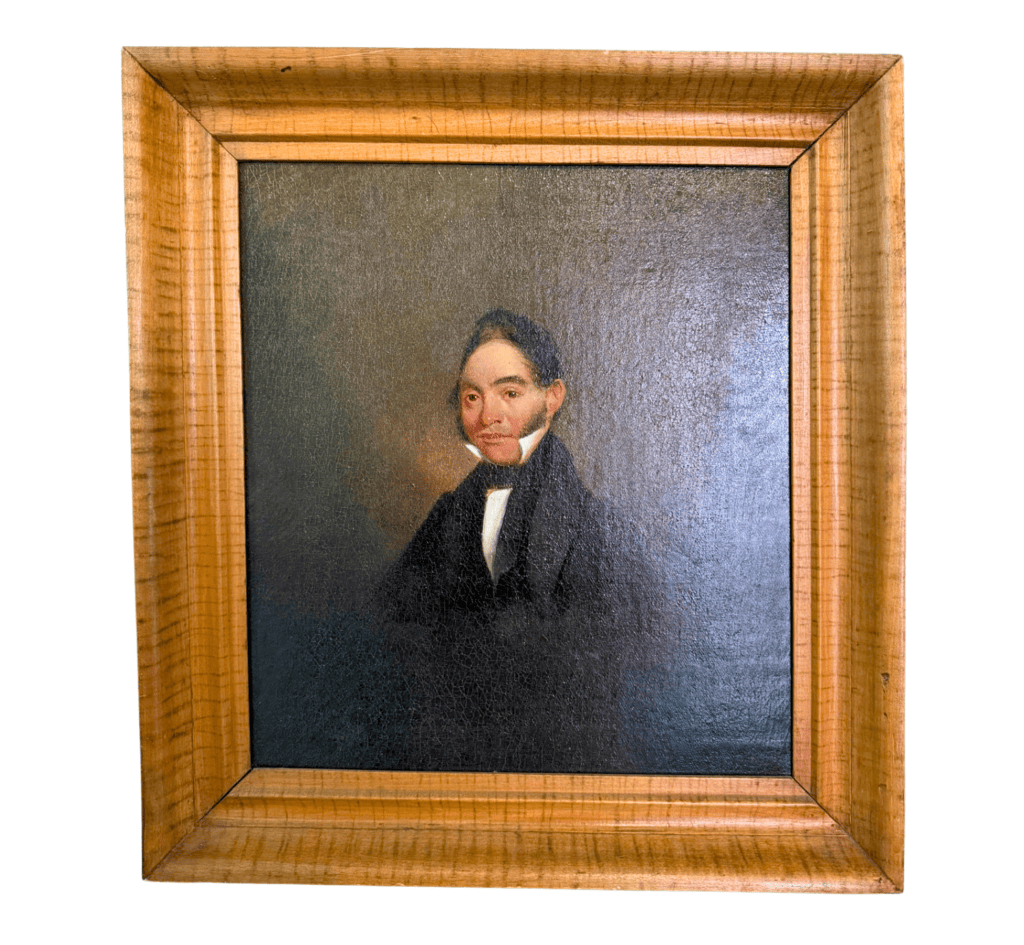
Born in 1821, Markell, the third of five children born to Samuel and Amelia Schley Markell, was reportedly already an accomplished watercolorist by the age of 8. At 17, he could be found in Philadelphia, a student of renowned artist, Thomas Sully.  His course work with Sully was left unfinished when he returned to Frederick due to his older brother William being very ill and dying suddenly at just 23 years old in April of 1839.  

Markell then traveled the region as an itinerant painter, advertising in June of that year in Leesburg, Virginia that he welcomed those interested in having their portraits made to come to his lodgings and review his work.  Markell had plans to travel to Italy to continue his studies but his life was also tragically cut short.  Like his older brother, Markell died at 23 years of age on December 2, 1844.  

Surviving today, 181 years later in the collection of Heritage Frederick are many works by John Markell, including early watercolors, portraits and a stunning landscape of Frederick as viewed from Prospect Hill in July 1844.  Two of John Markell’s self portraits also reside in the collection, one he completed when he was 17 years old and the other when he was 22 painted just 10 months before his death.

The new gift, Portrait of an Unidentified Man, was given in September by Charles Markell, III.

This article by Amy Hunt, Heritage Frederick Curator, was originally featured in the November 2025 edition of Frederick magazine. To see the original article, click here >>
Oldfields: Frederick County’s Last Surviving Rosenwald School

Over 5,000 schools for African American students were built between 1917 and 1931 across the southern United States through the collaboration of educator and author Booker T. Washington and Julius Rosenwald, President of Sears, Roebuck, and Company. The Rosenwald Foundation provided matching grants to over 150 school projects in Maryland, including the Oldfields School.

Oldfields is a historically Black community located at the intersection of New Windsor and Coppermine Roads, near Libertytown. Several families in Oldfields joined together to purchase land in 1871 “for the purpose of erecting a house thereon to be used for a school house and to worship in.” In 1883, Keys Chapel was dedicated on this site. 

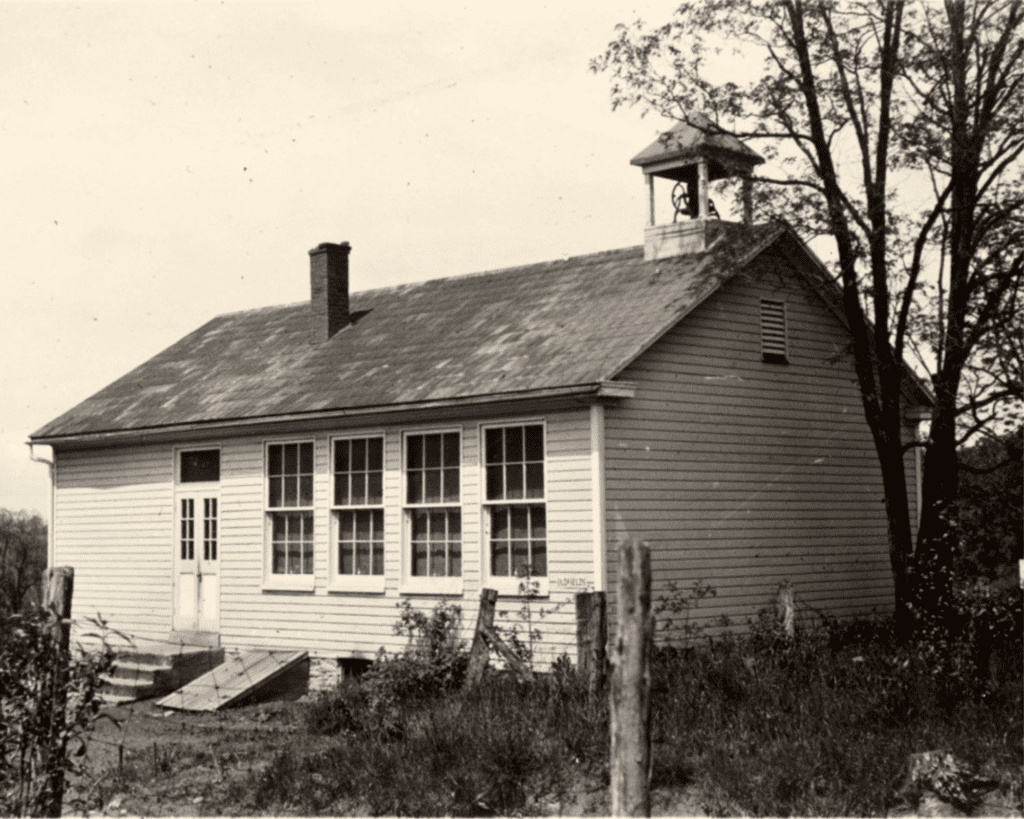
Families in Oldfields raised funds and secured a grant from the Rosenwald Foundation in 1918 to build a larger dedicated school building. As seen in this photograph, the new school contained a classroom and two cloakrooms and was built using plans prepared at the Tuskegee Institute. 

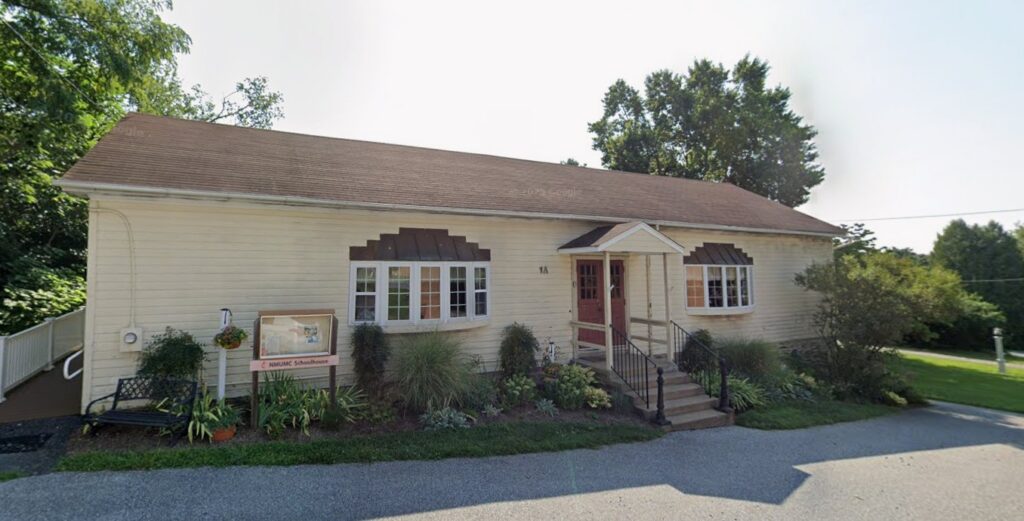
The population of Oldfields declined during the Great Depression and the school closed in 1935. Four years later, County Superintendent Eugene W. Pruitt proposed using the Oldfields building to replace the century-old segregated school in New Market. During the fall of 1939, contractor William Cookerly moved the structure over ten miles from Oldfields to New Market and constructed an extension to accommodate a second classroom.

After the integration of New Market Elementary School in 1961, the former segregated schoolhouse was acquired by New Market United Methodist Church. Today, the structure is the only surviving Rosenwald School in Frederick County.

This article by Jody Brumage, Heritage Frederick Archivist and Museum Manager, was originally featured in the August 2026 edition of Frederick magazine. To see the original article, click here >>

Patriotic Display

Freedom in America began with a Revolution –brave people, willing to put themselves in danger to stand up for the rights of their neighbors and friends – a melting pot of immigrant families from many parts of the World, looking for a better life, hopeful but not yet sure what “being American” would mean.

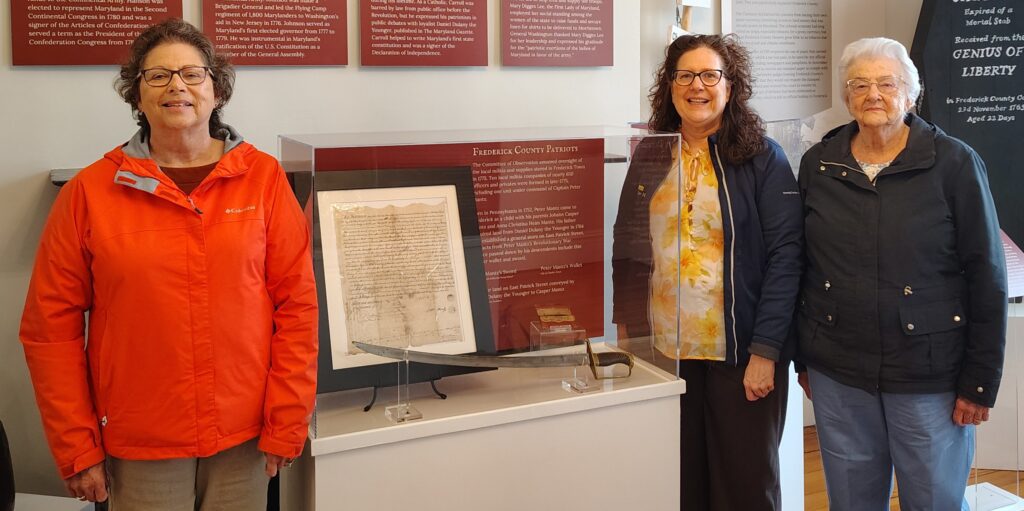
Peter Mantz was 23 years old in July 1776.  Raised in Frederick, he was one of nine children of German immigrant parents Johann Casper and Anna Christina Heim Mantz who ran a general store on East Patrick Street.

Major Peter Mantz’s Revolutionary War Sword.
Gift of Elizabeth Robinette Kemp Roszel.

Following the adoption of the Declaration of Independence, two hundred and fifty years ago this month, Maryland patriots at the request of the Continental Congress began organizing the Flying Camp, an active-duty militia of 10,000 men from PA, MD and DE that would be constantly on the move to give support to the Continental Army, wherever needed.  Peter Mantz was selected to lead one of ten local companies. Mantz, with just over 80 men, supported the movements of General George Washington and the Continental Army in defense of New York City as well as their retreat through New Jersey and back across the Delaware River.

Following his Revolutionary service, Mantz went on to be a militia recruiter, a land surveyor and speculator, a tax commissioner, a Maryland legislator and the County Sheriff.  He married and raised 11 children of his own in Frederick. On view as part of Heritage Frederick’s Cultivating Independence: Frederick County in the Revolution exhibition are the Revolutionary war sword of Peter Mantz and a leather wallet that belonged to him later in life. Earlier this year, sisters and Peter Mantz descendants Joan and Bonnie, along with their mother Helen, stopped in to view their own Frederick County History after being identified and contacted by staff.

This article by Amy Hunt, Heritage Frederick Curator, was originally featured in the July 2026 edition of Frederick magazine. To see the original article, click here >>
Camp History

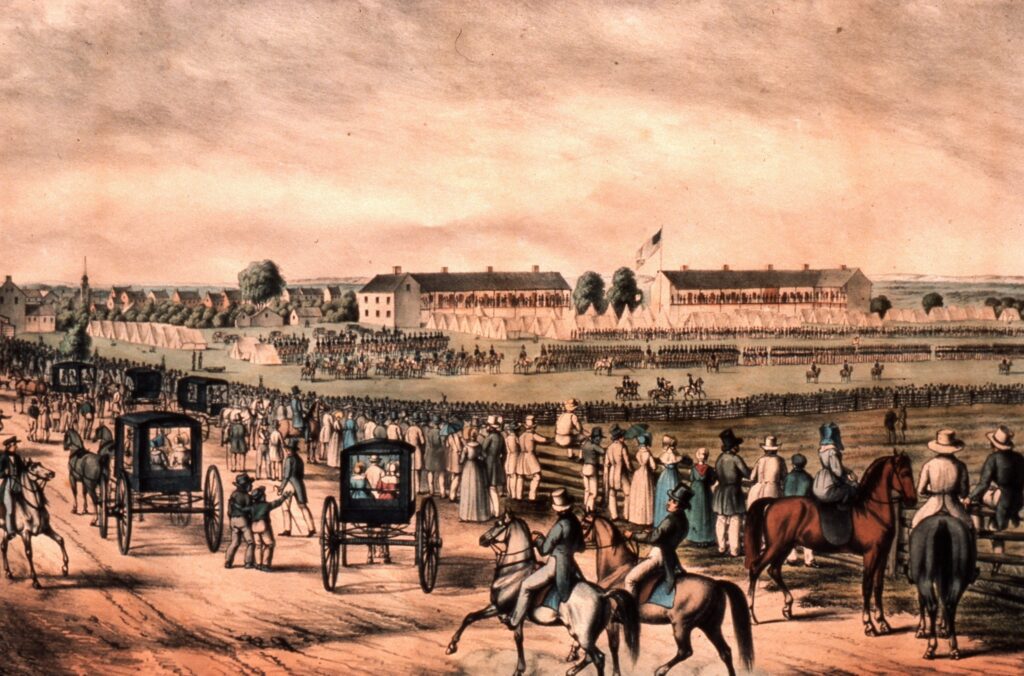
Few local landmarks have stood witness to more pivotal moments of American history than the Hessian Barracks. Constructed between 1777 and 1781, thousands of British and German prisoners were held at the Barracks during the Revolutionary War. Supplies for the Lewis and Clark Expedition were gathered here in 1804. During the War of 1812, the Barracks housed local militia units and captured British soldiers. The stone Barracks were already 60-years-old when Frederick artist John Johnston Markell painted them in this scene of an 1843 encampment of the Maryland Militia.

In July 1861, 1,000 soldiers of the 1st Regiment Pennsylvania Volunteers camped at the Barracks. Confederate forces had fired on United States soldiers at Fort Sumter in South Carolina barely three months earlier. On July 4, 1861, hundreds of Frederick residents gathered alongside the soldiers at the Barracks to hear the reading of the Declaration of Independence and a speech by Col. William P. Maulsby.

A deep sense of anxiety must have pervaded the scene at the Barracks on this unusual Fourth of July. Jacob Engelbrecht noted that unlike the usual raucous Independence Day celebrations of the past, “I saw no person intoxicated…all went off peaceably and quiet.” Less than three weeks later, the Confederate and United States armies clashed in the first full-scale battle of the Civil War at Manassas, Virginia. In the coming years, thousands of soldiers marched through Frederick County, received care in local field hospitals, and ultimately won a victory that achieved the abolition of chattel slavery and an unprecedented expansion of the promises made in the founding document of our nation.

This article by Jody Brumage, Heritage Frederick Archivist and Museum Manager, was originally featured in the July 2026 edition of Frederick magazine. To see the original article, click here >>
Dairy Delights

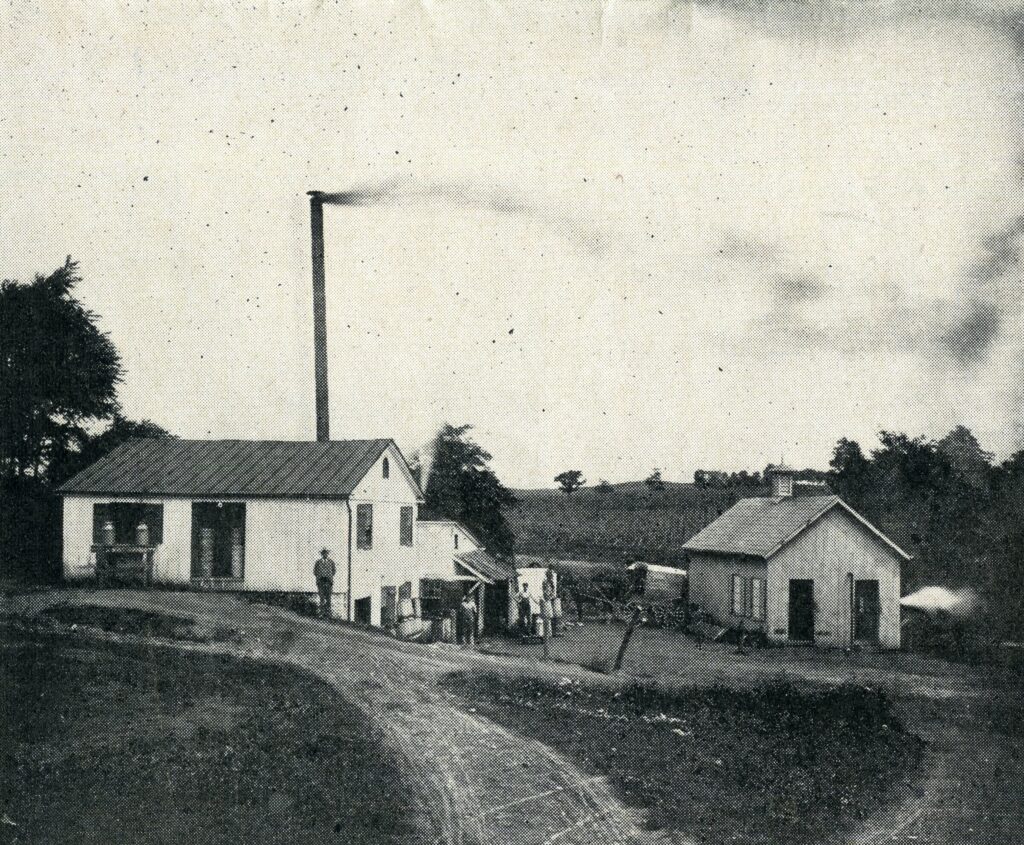
Augustus Nicodemus, Sr., established a creamery in Buckeystown in 1887. The introduction of centrifugal separators by manufacturers like Gustaf de Laval expedited the processing of milk and cream, enabling the mechanization of a task that was traditionally done by hand in the home. Frederick County farmers harnessed this technology to make dairy a leading agricultural industry in the county, shipping products to the markets of growing cities like Baltimore, Philadelphia, and Washington, DC, via local railroad networks. 

A.W. Nicodemus and Sons processed milk and cream and produced ice cream in their Buckeystown plant, expanding the business by establishing branch factories in Hyattstown and Urbana as well as Woodstock, Virginia. When this photograph of the Buckeystown plant was taken in 1904, Nicodemus and Sons were processing up to 2,000 gallons of milk and 400 gallons of cream every day and up to 600 gallons of ice cream weekly. 

In 1921, Nicodemus and Sons relocated their operation to Frederick, selling the Buckeystown plant to Chapin-Sacks Manufacturing Company. The new Frederick plant was built on East Patrick Street near Carroll Creek. Two years later, the Nicodemus company constructed 10 bungalow style houses for workers and their families along Pennsylvania Avenue. 

Three generations of Nicodemus family management of the creamery came to a conclusion in 1961 when the business was sold to Karlin, Inc. Today, the site of the Nicodemus creamery continues to serve as a dairy processing facility, now under management of Saputo.

This article by Jody Brumage, Heritage Frederick Archivist and Museum Manager, was originally published in the June 2026 edition of Frederick magazine. To see the original article, click here >>