
Frederick photographer Margaret “Patsy” Storm Moore captured this incredible view of 150 years of transportation history. Taken from the original roadway of the Baltimore and Frederick Town Turnpike, Moore’s photograph shows three crossings over the Monocacy River.
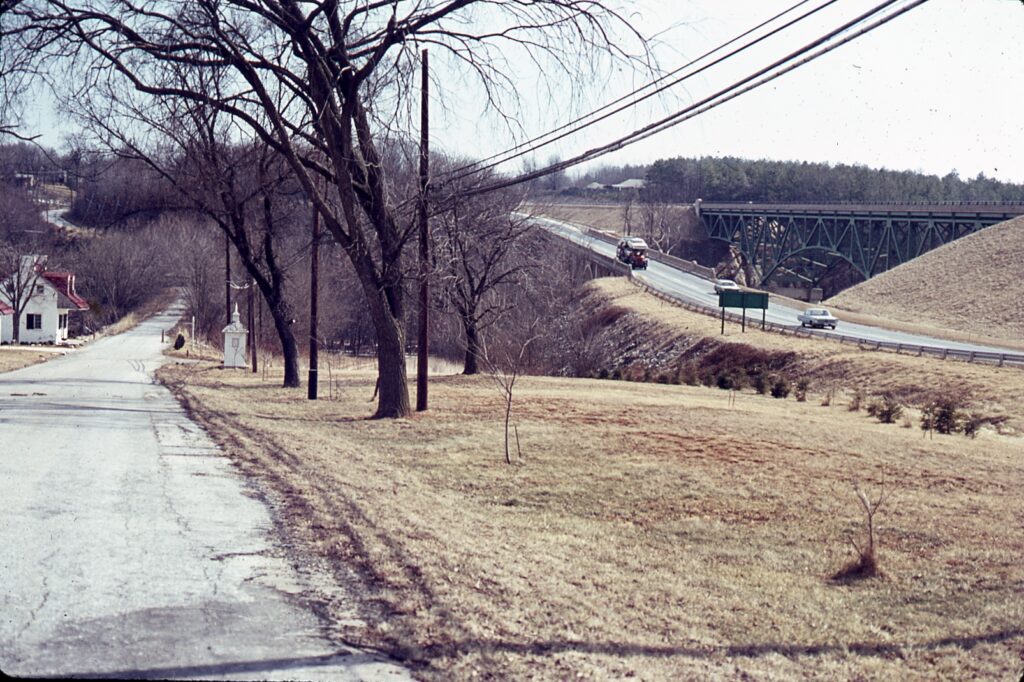
Visible at the far left is the historic tollhouse built around 1808 on the turnpike. Just beyond the tollhouse, the roadway continues toward the site of the first Monocacy River Bridge, an impressive span of four 65-foot stone arches built by Leonard Harbaugh and opened in 1808. Known as “Jug Bridge” for its unique demijohn shaped stone ornament that adorned its eastern wing wall, this structure witnessed several historic events including the welcoming reception of the Marquis de Lafayette in 1824 and the Battle of Monocacy in 1864.
On March 3, 1942, a span of the 134-year-old Jug Bridge collapsed. The remaining arches were soon demolished and a temporary wooden roadway set atop the stone piers to carry traffic while a new concrete bridge was constructed south of the original crossing. The concrete bridge opened in 1944 and is seen near the center of the photograph.

The construction of Interstate 70 initially followed the route of the old turnpike. An iron truss bridge, seen to the right in the photograph, was completed in 1956 to carry eastbound traffic next to the 1944 structure, which became the westbound crossing. After I-70 was rerouted to the north in 1985, the third bridge became the sole span carrying MD-144 over the Monocacy River. This bridge remains in use today, though the closed concrete bridge still stands next to it.
This article by Jody Brumage, Heritage Frederick Archivist and Museum Manager, was originally featured in the August 2026 edition of Frederick magazine. To see the original article, click here >>