
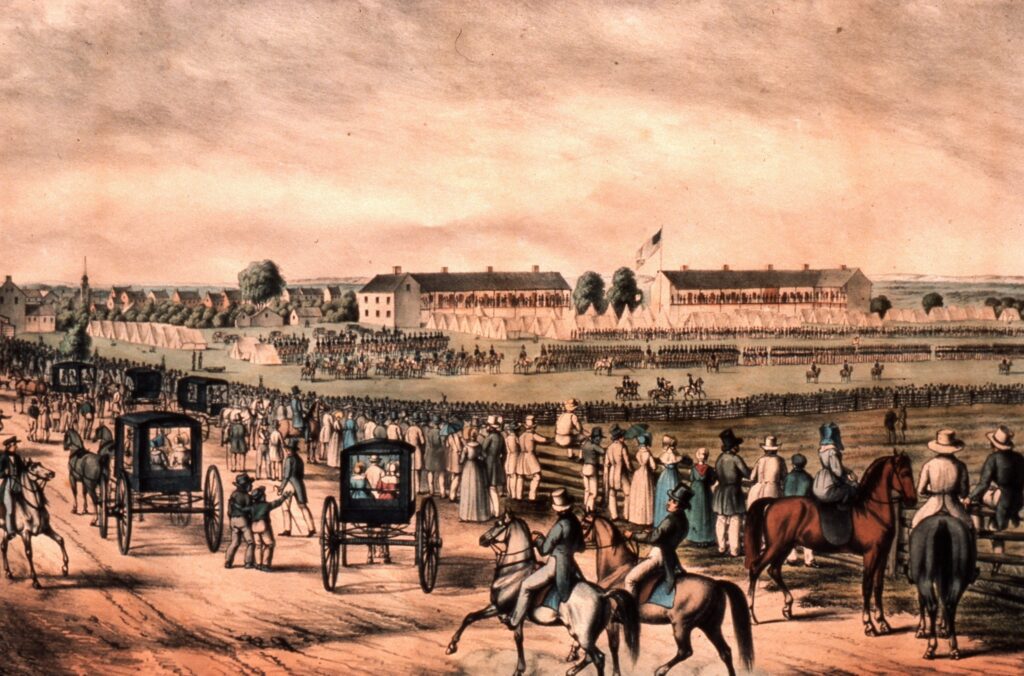
Few local landmarks have stood witness to more pivotal moments of American history than the Hessian Barracks. Constructed between 1777 and 1781, thousands of British and German prisoners were held at the Barracks during the Revolutionary War. Supplies for the Lewis and Clark Expedition were gathered here in 1804. During the War of 1812, the Barracks housed local militia units and captured British soldiers. The stone Barracks were already 60-years-old when Frederick artist John Johnston Markell painted them in this scene of an 1843 encampment of the Maryland Militia.
In July 1861, 1,000 soldiers of the 1st Regiment Pennsylvania Volunteers camped at the Barracks. Confederate forces had fired on United States soldiers at Fort Sumter in South Carolina barely three months earlier. On July 4, 1861, hundreds of Frederick residents gathered alongside the soldiers at the Barracks to hear the reading of the Declaration of Independence and a speech by Col. William P. Maulsby.
A deep sense of anxiety must have pervaded the scene at the Barracks on this unusual Fourth of July. Jacob Engelbrecht noted that unlike the usual raucous Independence Day celebrations of the past, “I saw no person intoxicated…all went off peaceably and quiet.” Less than three weeks later, the Confederate and United States armies clashed in the first full-scale battle of the Civil War at Manassas, Virginia. In the coming years, thousands of soldiers marched through Frederick County, received care in local field hospitals, and ultimately won a victory that achieved the abolition of chattel slavery and an unprecedented expansion of the promises made in the founding document of our nation.
This article by Jody Brumage, Heritage Frederick Archivist and Museum Manager, was originally featured in the July 2026 edition of Frederick magazine. To see the original article, click here >>